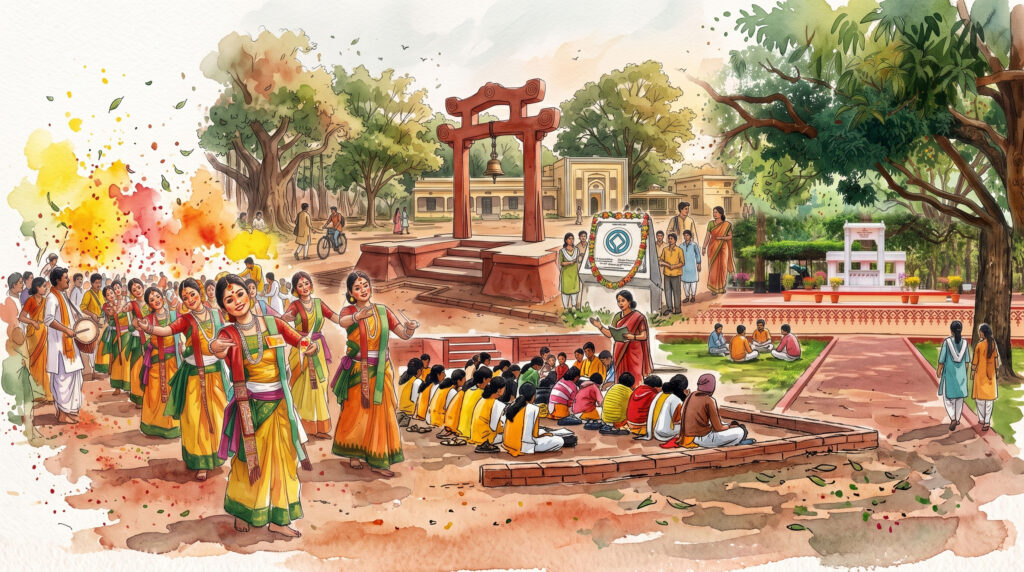
In September 2023, Santiniketan earned global recognition as India’s 41st UNESCO World Heritage site. Far from being a quiet open-air museum of static monuments, Santiniketan is celebrated as a living university and cultural landscape—a place where classrooms thrive under the shade of mango groves, artistic expressions blend with everyday life, and Rabindranath Tagore’s timeless ideals continue to breathe.
Whether you are an architecture enthusiast, history lover, or mindful traveller, understanding this heritage inscription will deepen your experience walking down Santiniketan’s red-earth paths.
Why Did Santiniketan Receive World Heritage Status?
UNESCO inscribed Santiniketan under cultural criteria, acknowledging it as an exceptional model of early 20th-century Asian modernity.
-
Reimagining Education: In 1901, Rabindranath Tagore established Patha Bhavana as an intentional break from rigid British colonial schooling. He brought learning out into open nature, replacing four-walled confinement with open skies and trees.
-
Global Internationalism (Visva-Bharati): Founded in 1921 under the motto “Yatra Visvam Bhavatyekanidam” (“Where the world makes its home in a single nest”), the institution brought together scholars, artists, and thinkers from across the globe.
-
A Pan-Asian Architectural Identity: Instead of replicating Western classical styles, Santiniketan’s architecture merged Indian rural traditions (terracotta, mud, thatch) with Indonesian, Japanese, and Chinese influences.
-
Integration of Art in Life: Through masters like Nandalal Bose, Ramkinkar Baij, and Benode Behari Mukherjee, fine art moved out of elitist galleries and into public walls, pathways, and everyday surroundings.
Core World Heritage Landmarks to Explore
The core heritage zone encompasses the original Ashram precinct and the Uttarayan complex. Key stops include:
-
Chhatimtala: The spiritual cradle of Santiniketan, where Maharshi Debendranath Tagore meditated under two Chhatim trees in 1863 and found inner peace.
-
Upasana Griha (The Glass Temple): Built in the late 19th century with Belgian stained glass and marble seating, hosting serene non-denominational weekly prayer services.
-
Santiniketan Griha: The original two-storied house built by Debendranath Tagore, representing the architectural starting point of the town.
-
Uttarayan Complex: Gurudev Tagore’s five experimental residential houses—Udayan, Konarka, Shyamali, Punashcha, and Udichi—each reflecting varied sustainable and vernacular styles.
-
Patha Bhavana & Saalbithi: The living school grounds where students still attend open-air classes along tree-lined avenues.
-
Open-Air Sculptures: Iconic modernist public sculptures by Ramkinkar Baij, including Santhal Family and Mill Call, situated within the Kala Bhavana grounds.
Travel Practicalities for Visitors
-
Best Way to Visit: To explore the core Ashram precinct, join the official Visva-Bharati Heritage Walk, conducted on Fridays, Saturdays, and Sundays with university guides. Tickets are issued at the Rabindra Bhavana counter.
-
Preserving the Site: The core zone is both an active academic institution and a fragile heritage precinct. Maintain silence around open-air classrooms, stay along marked paths, avoid touching historic mud murals, and observe strict no-littering rules.
-
Photography Rules: Personal mobile photography is permitted in public garden pathways, but vlogging, tripods, and commercial videography are strictly prohibited inside the heritage zone.