
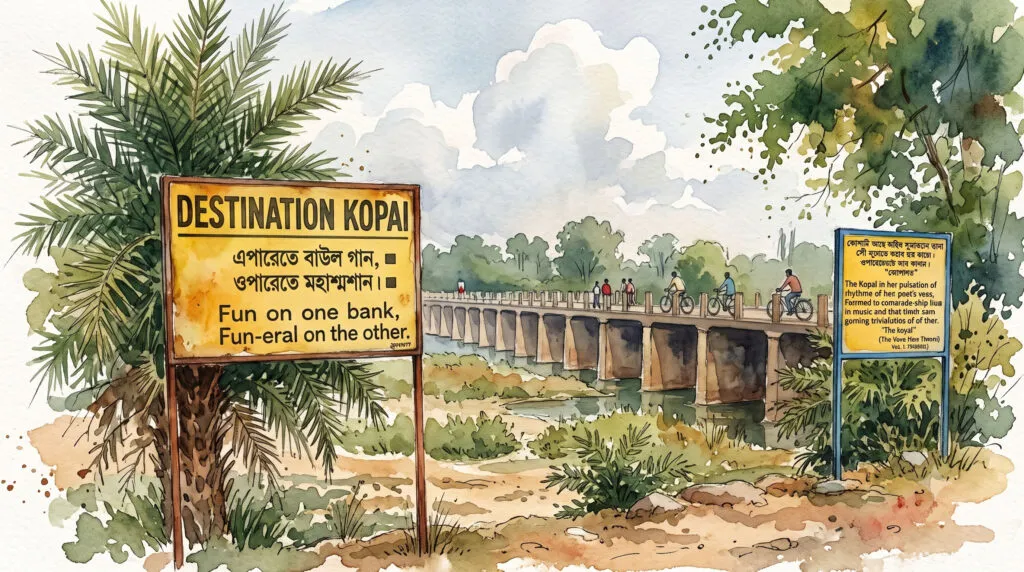
“আমাদের ছোট নদী চলে বাঁকে বাঁকে,
বৈশাখ মাসে তার হাঁটু জল থাকে…”
(Our little stream flows in graceful bends. In the dry heat of Baisakh, knee-deep it wends.)
Winding past red-soil ravines and green groves, the Kopai River Santiniketan stands as the poetic lifeline of Tagore’s countryside. Every Bengali child grows up reciting these rhythmic lines from Tagore’s Sahaj Path. Long before travelers reach Santiniketan, they picture this gentle stream framed by blooming white kash flowers.
First, the Kopai represents far more than an ordinary rural waterway. While the mighty Padma inspired Tagore’s early verse, this humble Birbhum stream captured his heart later in life. Today, visiting its quiet banks offers the purest taste of rural Bengal. Below, explore its geography, literary legacy, riverside villages, best viewpoints, and eco-friendly travel tips.

Kopai River Santiniketan: Key Facts at a Glance
| Feature | Details & Visitor Notes |
|---|---|
| River Name | Kopai River (কোপাই নদী / Sal River in upper reaches) |
| Origin & Length | Originates near Khajuri (Jamtara, Jharkhand); flows ~107 km across Birbhum |
| Confluence | Meets the Bakreshwar River near Labhpur before joining the Mayurakshi |
| Distance from Santiniketan | Approx. 4 to 6 km north of the core ashram (15 minutes by toto or bicycle) |
| Best Season to Visit | Autumn (Sept–Oct for kash blooms) and Winter (Nov–Feb for golden sunsets) |
| Top Riverside Villages | Goalpara, Ballavpur, Shyambati, and Kankalitala |
| Entry Fee | Free public access along bridges, village trails, and temple ghats |
Geography: Where the Kopai Starts and Flows
The Kopai is an ephemeral, rain-fed stream born near Khajuri village in Jharkhand. From there, it enters the red lateritic Rarh plains of Birbhum, tracing a graceful 107-kilometer path eastward.
Depending on the season you visit, the river reveals two distinct personalities:
- Winter & Summer (November to May): First, the stream shrinks into a sunlit trickle barely knee-deep. Broad stretches of clean white sandbars emerge where egrets and kingfishers wade peacefully.
- Monsoon (July to September): Next, heavy rains transform the gentle brook into a spirited, chocolate-red current. The water swells to its grassy banks, reminding visitors of its natural seasonal force.
- River Confluence: Finally, after skirting Santiniketan, the Kopai joins the Bakreshwar River near Labhpur Fullaratala and flows toward the Mayurakshi–Bhagirathi basin.
Tagore & Tarasankar: Literary Romance with the River
The Kopai River Santiniketan inspired two titans of modern Bengali literature:
- Tagore’s Poem Kopai (1932): First, Rabindranath Tagore immortalized the stream in his poetry book Punashcha. He affectionately compared the Kopai to a playful village girl hopping over red gravel bends.
- Tarasankar Bandyopadhyay’s Classic: Second, Jnanpith-winning writer Tarasankar Bandyopadhyay set Hansuli Banker Upakatha along the sickle-shaped river bend near Labhpur.
- Campus Inspiration: Finally, Tagore named his wheelchair-accessible garden home Punashcha after the very book that celebrated this river.
The Villages Breathing Along Its Banks
Several quiet hamlets border the river where rural life still moves at an unhurried rhythm:
- Goalpara: First, this peaceful village of kantha-stitch artisans features mud-plastered cottages painted with white alpona murals. Dirt trails wind straight from the village down to the water.
- Ballavpur & Shyambati: Second, this forested stretch sits behind Ballavpur Wildlife Sanctuary and Sonajhuri Haat, pairing tall sal trees with cool breezes.
- Kankalitala: Third, located 9 km southeast of Bolpur, the river curves directly behind the sacred Kankalitala Shakti Peetha temple ghat.
- Nichinta & Perua: Finally, these traditional farming hamlets let you watch bullock carts cross shallow riverbeds beside seasonal mustard fields.
Ecological Science: Protecting the Fragile Khoai Basin
Beyond poetry, the Kopai basin has drawn decades of geomorphological research at Visva-Bharati University. Renowned geographer Prof. (Dr.) Malay Mukhopadhyay mapped the hydrology of this basin, highlighting three urgent conservation truths:
- Fragile Badland Ravines: First, monsoon run-offs take centuries to carve the dramatic Khoai canyons along the river. Unchecked construction can destroy these delicate formations within months.
- Riverbed Protection: Second, illegal sand mining and brick kilns threaten natural bank stability and local groundwater tables.
- Responsible Tourism: Finally, travelers must treat the river as a living heritage ecosystem rather than a disposable picnic backdrop.
Best Viewpoints & How to Visit Kopai River
To enjoy an unhurried morning walk or golden-hour sunset by the water, visit these top spots:
- 1. The Kopai Bridge: First, stand on the Goalpara–Ballavpur bridge for sweeping views of river bends framed by palash trees and autumn kash blooms.
- 2. The Trail Beyond Sonajhuri: Second, after browsing crafts at Khowai Sanibarer Haat, walk north through the forest until red ravines open onto the sandy bank.
- 3. Kankalitala Temple Ghat: Third, sit on the shaded brick steps behind Kankalitala Temple to watch local fishermen and enjoy serene spiritual calm.
- How to Reach & Nearby Planning: Finally, hire a bicycle or toto from Bolpur Station (about 15 minutes). Check train timings in our Bolpur Santiniketan train time table, find eco-stays in our Where to Stay directory, taste authentic Bengali meals at local restaurants, and browse our Bolpur Santiniketan travel guide.