
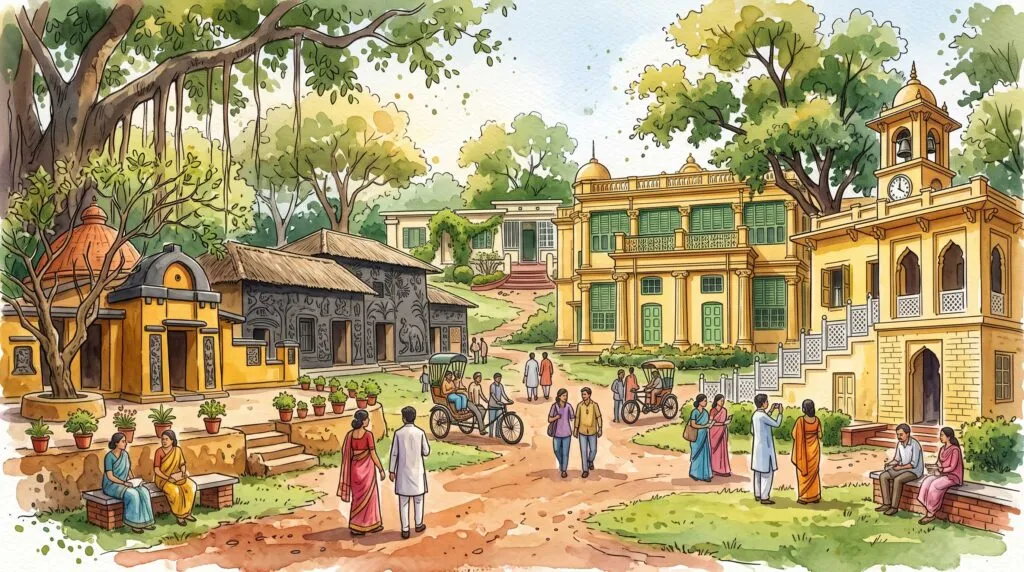
Walking through Santiniketan reveals that Rabindranath Tagore was not only an acclaimed poet and philosopher, but also an adventurous architectural thinker. He fundamentally resisted the idea of living inside static, boxed-in brick quarters. As his creative phases, seasons, and physical health changed, Tagore conceived and lived in a series of distinct residences—each designed as a continuous dialogue between vernacular building crafts, human living spaces, and natural light.
Today, these dwellings form the emotional and architectural core of the UNESCO World Heritage site. Here is your complete traveler’s guide to the historic houses of Santiniketan, spanning the early Ashram estate to the famous five experimental dwellings of the Uttarayan Complex.
The Early Foundations: Historic Ashram Residences
Before the development of the northern Uttarayan complex, the spiritual and daily life of the Ashram revolved around these seminal structures:
-
Santiniketan Griha (1863): The earliest permanent house in the area, constructed by Maharshi Debendranath Tagore (Rabindranath’s father). Its distinct red-tiled roof, cast-iron lattice verandahs, and colonial-vernacular manor style gave the entire settlement its name, Santiniketan (“Abode of Peace”).
-
Natun Bari (1902): A simple, thatched, two-story cottage planned with the help of W.W. Pearson. Rabindranath lived here with his wife Mrinalini Devi and their children during the foundational years of Patha Bhavana.
-
Dehali (1904): A modest two-storied brick house where Tagore stayed following the demise of his wife, pouring his grief into profound meditative verse and song.
The 5 Iconic Houses of Uttarayan Complex
Built between 1919 and 1941, the Uttarayan Complex represents Tagore’s later architectural playground. Designed in close collaboration with his son Rathindranath Tagore, master artist Nandalal Bose, and architect Surendranath Kar, these five houses fuse Japanese spatial aesthetics, Javanese woodwork, and traditional Bengali earthen craftsmanship.
1. Konarka (1919)
-
Design & Concept: The first house built in Uttarayan, planned as an open summer retreat. It features wide open verandahs, deep eaves to deflect sun and rain, and large corner windows positioned to capture the prevailing south-easterly breeze.
-
Tagore’s Use: Gurudev composed numerous poems and plays sitting on its wide brick platform. Classes, rehearsals, and musical evenings frequently took place seamlessly across the room and adjoining lawns.
2. Udayan (Completed 1928)
-
Design & Concept: The grandest, multi-level residence in the complex. Udayan incorporates Japanese-style sliding wooden screens, decorative pillars, and layered terraced rooftops that cascade downward.
-
Historical Moments: Udayan was where distinguished global guests and leaders stayed when visiting Tagore, including Mahatma Gandhi and Jawaharlal Nehru.
3. Shyamali (1935)
-
Design & Concept: One of India’s most celebrated experimental mud residences. Built entirely of reinforced mud, clay, and thatch, Shyamali was designed to prove that traditional vernacular techniques could yield sustainable, cool, and artistically refined homes.
-
Artistic Touch: The outer walls and pillars feature bas-relief mud sculptures crafted directly by Nandalal Bose and Kala Bhavana students.
-
Gandhi’s Stay: When Mahatma Gandhi and Kasturba Gandhi visited Santiniketan in 1940, Gurudev hosted them at Shyamali to align with Gandhi’s deep respect for simplicity and village crafts.
4. Punashcha (1936)
-
Design & Concept: Built with crisp horizontal lines, flat open terraces, and direct access to flower beds. Tagore wanted a low, ground-level space where he could easily move outdoors in his wheelchair without climbing stairs.
-
Literary Link: The house shares its name with Tagore’s 1932 poetry volume Punashcha, marking his transition toward modern free-verse poetry.
5. Udichi (1939)
-
Design & Concept: The final residence built for Tagore in Uttarayan. As his health grew frail, physicians recommended staying above ground-level moisture and dust. Udichi was built as an elevated, two-story pillar-supported pavilion where he could rest upstairs with cool breezes and panoramic views of the treetops.
Quick Summary Table
| House Name | Year Built | Core Architectural Style | Key Highlight |
| Santiniketan Griha | 1863 | Colonial-Vernacular Manor | Built by Maharshi Debendranath |
| Konarka | 1919 | Open pavilion with wide terraces | Tagore’s earliest Uttarayan retreat |
| Udayan | 1928 | Multi-tier Japanese & Indian fusion | Hosted Mahatma Gandhi & Nehru |
| Shyamali | 1935 | Vernacular mud architecture | Earthen relief murals by Nandalal Bose |
| Punashcha | 1936 | Low-slung single-level garden home | Named after his free-verse poetry book |
| Udichi | 1939 | Elevated two-story pillar pavilion | Tagore’s final residential studio |
Visitor Tips & Entry Information
-
How to Visit: The Uttarayan houses are located directly behind the Rabindra Bhavana Museum complex on Uttarayan Road (about 3 km from Bolpur Railway Station).
-
Ticket Access: Entry to walk through the gardens and view the exterior architecture of all five Uttarayan houses is included with your Rabindra Bhavana Museum ticket, bought at the museum counter.
-
Heritage Conservation: To preserve these sensitive structures, visitors view the homes from the manicured lawns and garden walkways; entering inside the fragile rooms is restricted.
-
Best Time to Visit: Early morning or late afternoon between October and March offers comfortable weather to stroll through the complex.
Travel Tip: Combine your visit to Uttarayan with the official Visva-Bharati Heritage Walk (conducted on Fridays, Saturdays, and Sundays) to get a complete guided look at both the core Ashram buildings and Tagore’s historic residences.