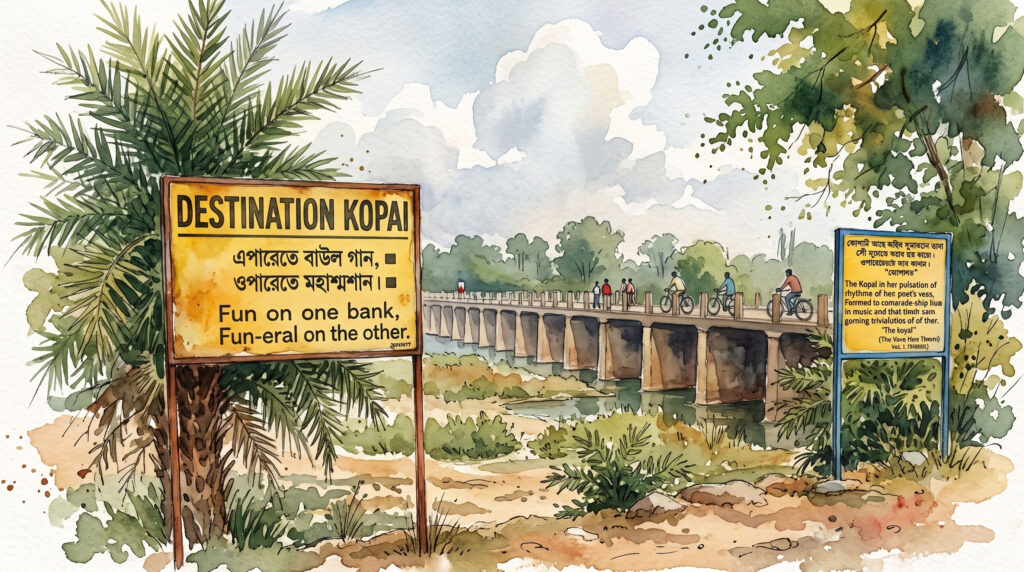
“আমাদের ছোট নদী চলে বাঁকে বাঁকে,
বৈশাখ মাসে তার হাঁটু জল থাকে…”
(Our little stream flows in graceful bends,
In the dry heat of Baisakh, knee-deep it wends…)
Every Bengali child grows up learning these rhythmically gentle lines from Rabindranath Tagore’s Sahaj Path. Long before visitors see the Kopai with their own eyes, they carry an imagined portrait of it in their minds: an unassuming red-soil rivulet winding lazily past groves of sal and palash, where white kash flowers sway in the autumn breeze and village kids plunge wicker traps into the clear shallows.
For Tagore, the Kopai wasn’t simply a body of flowing water. It was the living pulse of his pastoral world. While the majestic Padma in Shelaidaha inspired the vast, overwhelming mysticism of his earlier writing, it was this humble, red-banked stream in Birbhum that captured his heart in his later years. The Kopai taught that profound beauty does not need grand roaring cataracts; it lives quietly in graceful bends, grazing cattle, and the soft rustle of dry leaves along a sandy shore.
If you are planning an afternoon away from town chatter, heading towards the Kopai offers the purest taste of the rural Santiniketan Gurudev cherished.
Where It Starts and Where It Goes
The Kopai is an ephemeral, rain-fed stream born from the quiet scrublands of the Chota Nagpur fringe near Khajuri village in Jharkhand’s Jamtara district.
From there, it enters the laterite red plains—the ancient Rarh tract—of Birbhum, tracing a roughly 107-kilometre path eastward. After skirting the northern fringes of Santiniketan and blessing dozens of farming hamlets, the river meets the Bakreshwar River near Labhpur. Further downstream, the combined channel joins the Mayurakshi–Bhagirathi drainage network, eventually returning its red earth to the sea.
Depending on the month you visit, you will witness two completely different personalities:
-
Winter & Summer: A modest, sunlit trickle barely knee-deep, exposing stretches of white sandbars where egrets wade.
-
Monsoon (Sravana & Bhadra): A spirited, chocolate-red rush of water that swells to its banks, reminding everyone that this quiet stream holds serious elemental force.
Tagore’s Literary Romance with the River
In his later years, Tagore loved retreating to the rural edge near Kopai. He had an affectionate, almost familial bond with the stream. In Punashcha (1932), in his poem named simply Kopai, he wrote with tender fondness:
“কোপাই আমার ঘরের কাছেই… সে শান্ত নদীর মতো নহে, সে গ্রাম্য মেয়ের মতো চঞ্চল।”
He compared the Kopai not to a solemn, sacred river bound by temple rituals, but to a spirited, barefoot village girl hopping playfully over gravel and bends.
Later, Tarasankar Bandyopadhyay drew from the same riverbank terrain to compose his magnum opus Hansuli Banker Upakatha, capturing the life, folklore, and changing destinies of the Kahar community who settled on the sickle-shaped bend (hansuli bank) of the Kopai near Labhpur.
The Villages That Breathe Along Its Banks
The Kopai skirts several beloved hamlets around Bolpur where daily life still moves at an unhurried pace:
-
Goalpara: A peaceful village of kantha-stitch artisans and weavers. Walking through the mud-plastered huts with painted alpona leads you straight down to quiet dirt trails by the river.
-
Ballavpur & Shyambati: Nestled right behind the Ballavpur Wildlife Sanctuary and the Sonajhuri forest. This stretch is where tall trees, birdsong, and the river breeze come together.
-
Kankalitala: Downstream towards the southeast, where the river flows gently beside the sacred Shaktipeeth temple and rural cremation grounds, steeped in ancient lore.
-
Nichinta, Perua, and Chhora: Traditional farming hamlets where you can watch bullock carts cross dry riverbeds and farmers tending seasonal mustard and vegetable fields.
Looking at Kopai Through Science: Prof. Malay Mukhopadhyay’s Research
The Kopai isn’t just an inspiration for poets—it has drawn deep scientific curiosity from researchers right here at Visva-Bharati.
Prof. (Dr.) Malay Mukhopadhyay, a renowned geomorphologist and former Head of the Department of Geography at Visva-Bharati, has spent decades researching the physical geography and hydrology of the Kopai river basin. His studies have highlighted crucial aspects that every mindful traveler should appreciate:
-
A Fragile Badland Ecosystem: The dramatic ravines (Khoai) carved by rain gullies along the Kopai are ecologically fragile. They take centuries of natural erosion to form but can be destroyed within months by mindless construction.
-
Human Impact: His research maps the changing river cross-sections, bank erosion patterns, and the toll taken by unchecked sand-mining and brick-kiln activity along the basin.
-
A Living Entity: Prof. Mukhopadhyay has consistently championed the idea that Kopai must be protected as a living ecological heritage site, urging conservationists and travelers alike to treat the river with respect rather than viewing it merely as a scenic backdrop.
Where to Catch the Best Views of Kopai
If you want to spend an unhurried morning or catch the golden hour by the water, here are the best spots:
1. The Kopai Bridge (Near Goalpara / Ballavpur)
This is the quintessential vantage point. Standing on the bridge, you look out over gentle curves of the river framed by tall eucalyptus, palash, and wild vegetation. During autumn (September–October), the riverbanks turn pure white with blooming kash flowers.
2. The Trail Beyond Sonajhuri Forest
After taking in the handmade craft stalls at the Saturday Sonajhuri Haat, avoid heading straight back to town. Instead, hire a cycle or take a walking track winding through the back of the forest down towards the riverbank. The sudden opening of red ravines giving way to water is breathtaking.
3. Kankalitala Temple Ghat
About 9 km outside Bolpur, the river sweeps right behind the Kankalitala temple complex. There are stepped banks and shade trees where you can sit quietly, watch local fishermen, and take in the sacred, tranquil surroundings.
4. Rustic Riverside Cafes & Tea Stalls
Near Shyambati and the approach to the river, a few quiet earthen tea stalls and open-air cafes let you sip a piping-hot clay cup of cha while watching the afternoon sun dip behind the treeline.
A Few Thoughtful Notes for Travelers
-
Best Time of Day: Early mornings (around 6:30 AM to 8:30 AM) when the mist rises off the water and kingfishers dart across, or late afternoons (4:00 PM to 5:30 PM) for the sunset.
-
Getting Around: A local Toto driver will gladly take you on a leisurely 2-hour circuit covering Sonajhuri, the Kopai bridge, and back. If you enjoy slow travel, renting a bicycle from town is by far the most rewarding way to explore.
-
Keep It Pristine: The Kopai’s quiet beauty lies in its uncommercialised charm. Please carry your plastic bottles and wrappers back to town, and leave its peaceful banks just as clean as Tagore found them.