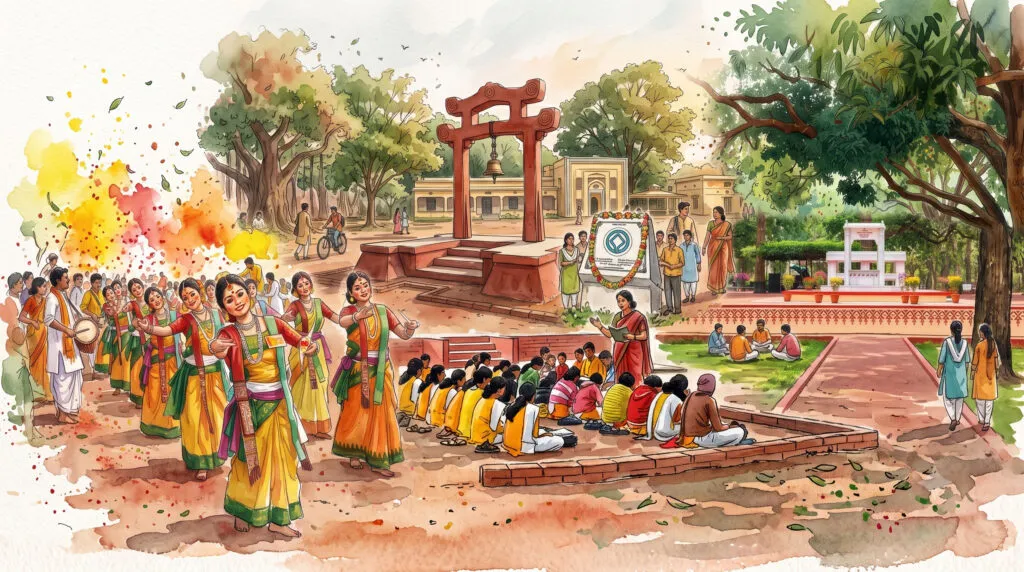
In September 2023, Santiniketan earned global fame as the Santiniketan UNESCO World Heritage site. It became India’s 41st World Heritage property. Far from being a static museum, this precinct thrives as a living university. Here, open-air classes flourish under mango groves, and Tagore’s timeless ideals continue to breathe.
First, understanding why UNESCO World Heritage Centre inscribed this campus deepens your visit. Below, explore the official inscription criteria, core monuments, and heritage walk rules.

Santiniketan UNESCO World Heritage: Key Facts at a Glance
| Feature | Official Inscription Details |
|---|---|
| Official UNESCO Title | Santiniketan (Cultural Landscape) |
| Date of Inscription | September 17, 2023 (45th World Heritage Committee Session) |
| UNESCO Criteria | Criteria (iv) and (vi) – Asian Modernity & Living Educational Philosophy |
| India Ranking | 41st UNESCO World Heritage Site in India (3rd in West Bengal) |
| Core & Buffer Area | 36 hectares (Core Zone) surrounded by a 537.73-hectare Buffer Zone |
| Custodian Institution | Visva-Bharati University (Central University) |
| Guided Tour Access | Official Santiniketan Heritage Walk (Friday to Sunday) |
Why Did Santiniketan Receive World Heritage Status?
UNESCO inscribed the Santiniketan UNESCO World Heritage property under cultural criteria (iv) and (vi). Consequently, the world recognized it as a bold model of early 20th-century Asian modernity:
- Reimagining Education: First, Rabindranath Tagore founded Patha Bhavana in 1901 to break away from rigid colonial schooling. Instead, he brought classes out under trees and open skies.
- Global Internationalism: Second, Tagore founded Visva-Bharati in 1921 under the motto “Yatra Visvam Bhavatyekanidam”. As a result, scholars and artists from Asia and Europe gathered here to share ideas.
- Pan-Asian Architectural Identity: Third, local architects rejected Western classical copies. Rather, they merged Bengali mud and thatch crafts with Japanese, Chinese, and Indonesian styles.
- Art Integrated into Daily Life: Finally, masters like Nandalal Bose and Ramkinkar Baij moved art out of galleries. Thus, murals and sculptures became part of everyday campus paths.
Core World Heritage Landmarks to Explore
The protected core zone spans the original Ashram precinct and the northern Uttarayan Complex:
- Chhatimtala: First, this spiritual cradle marks where Maharshi Debendranath Tagore meditated in 1863. Here, he found deep peace beneath two Chhatim trees.
- Upasana Griha (The Glass Temple): Second, builders completed this prayer hall in 1891 using colored Belgian glass. Today, it still hosts serene weekly prayer services.
- Santiniketan Griha: Third, Debendranath Tagore built this two-storied guest house in 1863. Eventually, this landmark gave the entire settlement its name.
- Heritage Houses of Santiniketan: In addition, visit Tagore’s five experimental homes inside Uttarayan. You can also see Singha Sadana and Gour Prangana nearby.
- Kala Bhavana Open-Air Sculptures: Finally, admire iconic sculptures by Ramkinkar Baij, including Santhal Family and Mill Call. They stand right beside Amrakunja.
Travel Practicalities & Visitor Rules
Because the Santiniketan UNESCO World Heritage site is an active university, visitors must follow clear conservation rules:
- Join the Guided Walk: First, book the official Santiniketan Heritage Walk at the Rabindra Bhavana counter. University guides lead these tours on Fridays, Saturdays, and Sundays.
- Respect Classroom Silence: Next, remember that Visva-Bharati closes every Thursday. On active class days, keep voices low near open-air classes and stay on marked paths.
- Strict Photography Etiquette: In addition, personal mobile photos are welcome in garden areas. However, tripods, drones, and commercial vlogging remain strictly banned inside the heritage zone.
- Plan Your Stay & Local Circuit: Finally, read our Heritage of Santiniketan overview and check trains in our train time table. You can also find stays in our Where to Stay directory and browse our Bolpur Santiniketan travel guide.
‘