
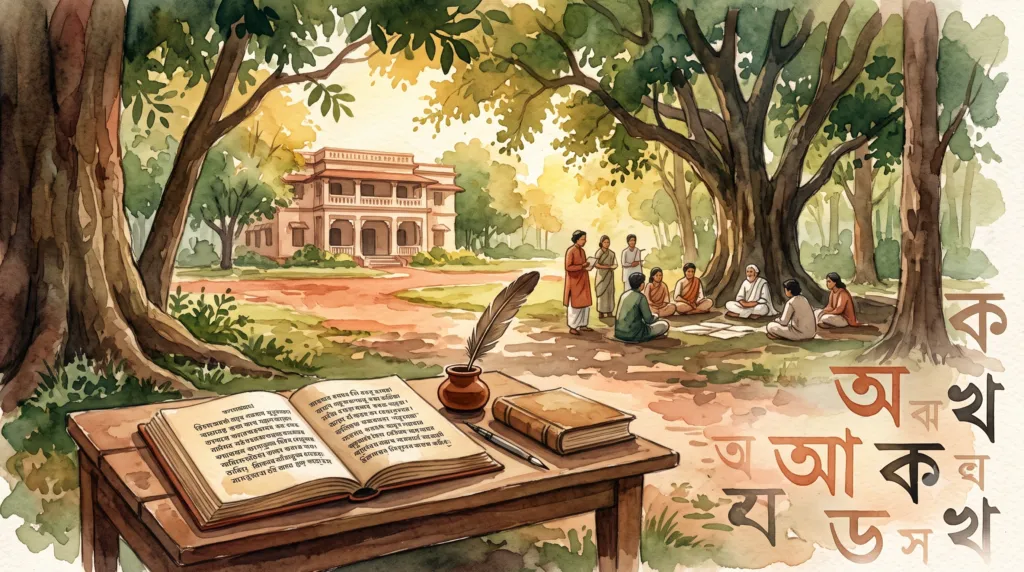
Nestled in the red-soil landscape of Bolpur-Santiniketan, Visva Bharati University is unlike any conventional university in India. It is not just an academic institution; it is a living philosophy shaped by nature, freedom, and cultural harmony.
The university takes its inspiration from the Sanskrit motto:
“Yatra viśvaṁ bhavatyekanīḍam” — “Where the whole world meets in one single nest.”
A Brief History of Visva Bharati
The roots of Visva Bharati go back to 1863, when Maharshi Debendranath Tagore founded an ashram in Bolpur as a retreat for spiritual meditation. Years later, in 1901, his son, Nobel Laureate Rabindranath Tagore, started an experimental open-air school called Brahmacharya Ashram with just five students.
Tagore envisioned an education system that broke away from rigid colonial classrooms. Using his Nobel Prize money and worldwide donations, he formally founded Visva Bharati in 1921. It became an international meeting place where scholars, artists, and thinkers from the East and the West gathered to learn together. In May 1951, an Act of Parliament declared Visva Bharati a Central University and an “Institution of National Importance,” with the Prime Minister traditionally serving as the Chancellor (Acharya). Today, Santiniketan stands proud as a UNESCO World Heritage Site.
Open Skies and Tree Canopy: The Unique Education Style
What makes Visva Bharati globally famous is its timeless educational style:
-
Open-Air Classrooms: Classes are held outdoors under the shade of ancient banyan, mango, and sal trees. Tagore believed that confinement inside four walls dampens a child’s natural curiosity.
-
Harmony with Nature: Environmental sensitivity is not learned from textbooks; it is lived every day. Birds chirping, gentle breezes, and changing seasons become part of the learning environment.
-
Art, Music, and Daily Life: Education here is holistic. Academic studies go hand-in-hand with fine arts, Rabindra Sangeet, classical dance, theatre, crafts, and yoga.
-
Community and Culture: Festivals like Basanta Utsav (Holi), Poush Mela, Briksharopan (tree planting), and Halakarshana (ploughing festival) teach students the deep cultural connection between human life and Mother Earth.
From Toddlers to PhD Scholars: Student Age Groups
Visva Bharati offers a continuous, lifelong learning journey on a single campus, welcoming learners of all age groups:
-
Patha Bhavana & Siksha Satra (Primary & Secondary School): Welcoming young minds from ages 5 to 17 years (from nursery and primary levels up to Class 12).
-
Undergraduate & Postgraduate Bhavanas: Serving students aged 18 to 25+ years in Bachelor’s and Master’s programs across humanities, sciences, fine arts, music, languages, and agriculture.
-
Research & Doctoral Centers: Catering to adult researchers and PhD scholars pursuing cutting-edge research, local rural development studies, and Rabindra literature.
Diverse Disciplines & Major Bhavanas (Institutes)
Visva Bharati blends classical academics with applied community sciences through dedicated Bhavanas (institutes):
-
Kala Bhavana: The internationally renowned institute for fine arts, painting, sculpture, and graphic art.
-
Sangit Bhavana: The home of Indian classical music, Rabindra Sangeet, Manipuri and Kathakali dance, and drama.
-
Vidya Bhavana: The core center for humanities, philosophy, history, and social sciences.
-
Bhasha Bhavana: A diverse hub dedicated to Indian and foreign languages, including Bengali, Sanskrit, Hindi, Chinese (Cheena Bhavana), Japanese (Nippon Bhavana), English, and European languages.
-
Siksha Bhavana: The faculty of science, covering disciplines like physics, chemistry, botany, zoology, mathematics, and biotechnology.
-
Palli Siksha Bhavana & Palli Samgathana Vibhaga (Sriniketan): Dedicated to agricultural sciences, rural reconstruction, handicrafts, weaving, and social work.
-
Vinaya Bhavana: Focused on teacher training, pedagogy, and physical education.
-
Rabindra Bhavana: The premier research institute and museum housing Tagore’s original manuscripts, paintings, archives, and personal artifacts.
Explore All Bhavanas & Departments Below
Discover the complete list of schools, academic institutes, and specialized departments operating across Santiniketan and Sriniketan campuses: